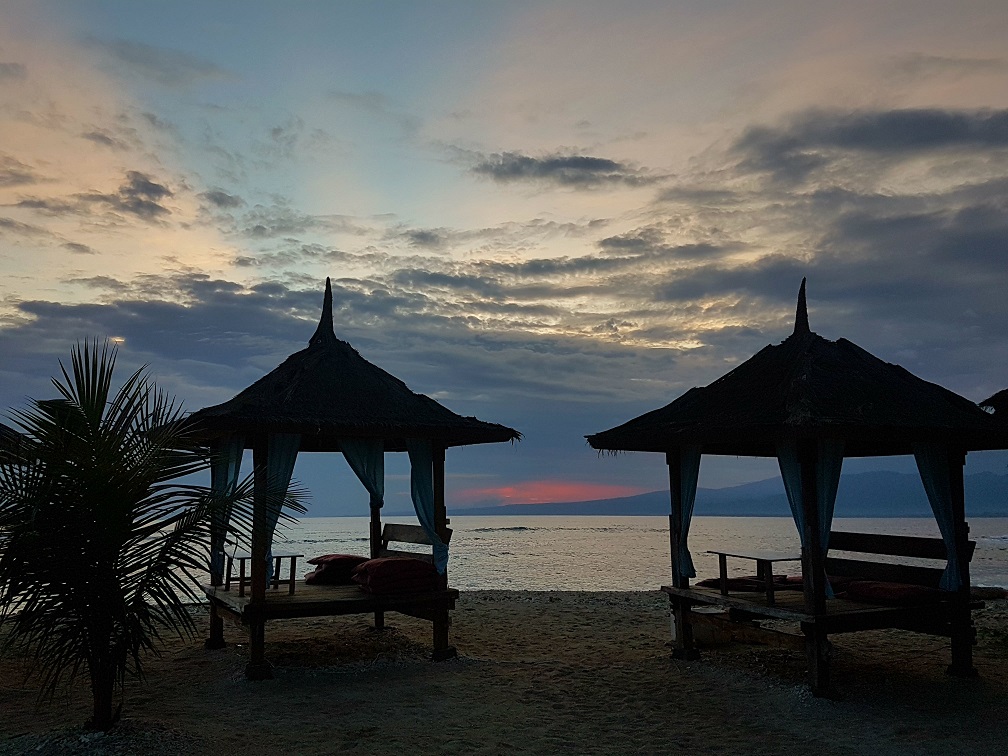
Tuesday, 18 July 2017

Land down under part 3 - Melbourne and Tasmania

Melbourne
Royal Exhibition Building
We were staying in the CBD (Central Business District) and in probably the dirtiest hostel we’d encountered so far. We spent the first day in Melbourne strolling round the city, visiting the laneways, including the famous Hosier Lane which is covered in graffiti and street art, Federation Square where street food and entertainers gather, and visiting the fantastic Melbourne Museum.
Grafitti on Hosier Lane

The next day we hired a car to drive down the Great Ocean Road and back, stopping in Geelong to catch up with our pal Dan, who we’d met in Goa all those months ago. We decided to take the highway to the end of the Great Ocean Road and make our way back to Melbourne.
Twelve Apostles

This was mainly to avoid the tourist buses who would have been doing it the other way round, finishing up where we started, at the Twelve Apostles which is large rock formation coming out of the sea. There are several large rocks – there used to be 9 but one has crumbled into the sea. We drove down to some other rock formations in the sea including London Bridge and Lock Ard Gorge

London Bridge
On the way back we stopped off for lunch and weirdly it was the exact same place I had been to for lunch when I had done the Great Ocean Road tour the year before. Baby D chose it even though there were several other places to eat, and several other towns to stop in, and I had no recollection of it until I went to the toilet!

Not sure where this was
We saw a sign to a lighthouse which was one of the well-known stops on the route, in Apollo Bay, but this was before lunch and as it was a 12km drive off the main road, we changed our minds about 3km along. We did pull over next to a Chinese family who were koala spotting and they pointed out several wild koalas to us which was great. There was no way we would have spotted them otherwise. We then stopped in Lorne to go to the beautiful Erskine waterfall.

Erskine waterfall
As darkness was falling we just had time to stop in Anglesea where we’d spotted another lighthouse at Split Point. The light was on as the sun was going down and we got some pretty good pictures. Turned out this was the lighthouse from the 90s kids TV show ‘Round the Twist’ so we were proper happy – we’d forgotten that the guide at the lighthouse in Augusta had told us it was in Victoria, and it was pure fluke we chose not to stop at the one in Apollo Bay and instead look at the one in Anglesea.

Split Point Lighthouse
We finally reached Geelong where we went for dinner with our friend Dan. It was great to catch up; some of the fun of travelling is catching up with people we’ve met and travelled a bit with. We were back in Melbourne around 1am and up the next morning for me to get my hair cut and for Baby D to go on the free city walking tour (which I had done in October). We then headed over to Footscray, about 15 minutes out of the city, for a meeting and lunch with a colleague who had just emigrated from the UK.

We were desperate for an early night, especially with an early flight in the morning but we wanted to see Dan again before we left Melbourne, and he met us in the city for some drinks and food. Too much beer and wine later, we were back at the hostel setting the alarm for 4 hours later to fly to Hobart, Tasmania.

Tasmania

Church in Hobart
Our hotel was above a pub and a 15 minute walk from Battery Point which is the centre of the city. Hobart is the capital of Tasmania, which is an island not much smaller than England about an hour and a half flight from Melbourne.

Salamanca market
Unlike England, the population of Tasmania is about 500,000 and this was really noticeable. We’d arrived in Tassie on a Saturday, and this was the day that the famous Salamanca market was on in Hobart.

We mooched around the harbour and the market for a few hours, before going to a great little fishy pub called The Drunken Admiral for some oysters and wine, and then going to the Indian restaurant next door for dinner and more wine. We couldn’t find anywhere to rent a campervan even though it was mid-winter, so we hired a car and got ready for a trip around the island.

Hobart boats
First of all, we wanted to see Mount Wellington which was about half an hour’s drive out of Hobart. When we got to the ‘starting point’ we saw that the road up to the top of the mountain was closed (probably because of the weather) so we couldn’t drive up.

Top of Mt Wellington
There were a few walks we could choose from instead of driving up, and we decided to do the full monty and climb to the top. What started as a sedate, leisurely walk with beautiful scenery, soon turned into a nightmare with strong winds whipping around us, hard snow and ice, and steep, treacherous trails leading up to the top. I thought I was sure to be blown off the mountain. During the summer, it would be a fabulous, easy climb, but in the winter, it was a different story. We met 3 other guys climbing, all of whom looked like they knew what they were getting into, and the lack of people on the mountain was probably an indicator of how difficult conditions were.

Top of Mt Wellington
At the top, we were met by hundreds of people in cars as they had re-opened the road soon after we set off on the hike. Typical. We could either climb the couple of km back down the mountain (not a cat in hell’s chance of that happening) or we could walk the 5.5km down the road. We were completely numb by this point so we cadged a lift off a nice couple, after one guy trying to charge us $10 each, and another guy pretending he wasn’t going down the road (there was no other way to go). When we had defrosted, we set off to Port Arthur, on a peninsula south east of Hobart.

Looking across Tasman National Park
There are a number of interesting places to see round Port Arthur, in Tasman National Park – a lot of the sights are similar to those on the Great Ocean Road, such as the Devil’s Kitchen, the Blowhole and the Tasman Arch. A weird phenomenon there is the tessellated pavement which is where the coastline has a tiled effect after millions of years of erosion of siltstone.

Tessellated pavement
After stopping at the various spots along the way, we went to the Unzoo. This is a wildlife park for Tasmanian devils, kangaroos, wallabies, birds and quolls. We got to feed the kangaroos and we saw the devils and the quolls being fed which was pretty savage.

Feeding time
They are all marsupials, but the devils and the quolls (which both look super-cute) are meat eaters and they soon turn aggressive in front of a bit of dead wallaby. Tasmanian devils have been suffering from facial tumour cancer which is spread through saliva mainly, and is fatal. Because they are aggressive over food, they bite each other on the face and this is how it is spread.

Tasmanian devils in the Unzoo
The cancer has massively knocked the numbers of devils on the island but thankfully it appears to have been eradicated on the Port Arthur peninsula. Interesting fact about the devils, their gestation period is 21 days and their offspring is only 4mm! Only a few of them will make it to the pouch though and the rest die off.
Tasmania was originally a convict island, and there is a famous historic site in Port Arthur illustrating this, but it was too expensive for us ($39 each) after spending $35 each to get into the Unzoo.

Wineglass Bay
Next stop in Tassie was Wineglass Bay further up the east coast. This beautiful spot is in the shape of the bowl of a wineglass, but no one is sure how the name came about – it might be the shape, or it might be the fact that the sea off the coast was often red wine coloured with whale blood as this was a big industry in days gone by.

Oysters
We visited some of the beautiful sites along the way including Coles Bay, stopping off at a place in the middle of nowhere for oysters.

Further down the road I spied a tiny wooden structure on the side of a road which was like a large bird house. On further investigation, we noticed that it was actually a dinky library with about 10 books in it.

Mini library
Once we got to Wineglass Bay, in Freycinet National Park we had to hike about 3km to the top to get the best views. 

Bay of Fires
That evening we carried on up the coast to the Bay of Fires, stopping in St Mary’s for the night.


Bay of Fires
We got up early the following morning to catch sunrise over the Bay, heading to Binalong Bay.
Sunrise over Bay of Fires
We just about made it before the sun appeared, and even though there were probably better viewing points, we found a tiny deserted beach to watch the sun come up. We spent the morning in the Bay of Fires, so-called because of the red rocks that make up the coastline, caused by red lichen. We were absolutely loving Tassie by now, it was stunning. 
Bay of Fires

As we didn’t have long on the island, we wanted to squeeze in as much as possible so we drove on, to a place called Sheffield, about 50km from Cradle Mountain, which was where we were off to on the following day. The B&B we’d booked was lovely, it was a proper house with a living room and real fire, and there was a family of 4 sharing with us. It was so nice to stay somewhere cosy and homely for a change.

Start of Ronny Creek
Cradle mountain view
Cradle Mountain is about 1500m high and there are several trails to walk if you don’t want to climb the mountain in its entirety. We took the shuttle bus to Ronny Creek and did a 6km circuit up to an altitude of about 1200m. It was a fairly easy walk with some steep parts and en route we saw several lakes, a waterfall and hundreds of wombats finally.
Back to Hobart for the night before heading to Cairns via a quick change in Sydney, to dive the Great Barrier Reef.

Tasmania used to get a bad rap – it is the butt of many an incest joke (how do you tell if someone's from Tassie? Look for the scar on their neck where they've had a head removed) but it is a beautiful island with so much to see and a tiny population living there. We will definitely be back and for longer than 5 days.


#melbourne #hosierlane #melbournemuseum
 #greatoceanroad #twelveapostles #lockardgorge #splitpoint #erskinewaterfall #tasmania #hobart #portarthur #wineglassbay #cradlemountain #salamancamarket #mountwellington #bayoffires#unzoo

Thursday, 13 July 2017

Land down under part 2 - Uluru, Kata Tjuta, Kings Canyon

Alice Springs, Uluru, Kata Tjuta and Kings Canyon
We flew up to Alice Springs from Adelaide which was the cheapest way to get there (and which was still not cheap). We had a night in a hostel in Alice Springs which was more like a mobile home, and we spent a bit of time walking round Alice. There is quite a large indigenous population and sadly homelessness and drinking appeared to be a widespread problem there for the aboriginal community; many of whom are living in poverty as a result of displacement. Alice Springs is a strange little town; basic and functional with nothing that really stands out part from the beautiful surrounding desert landscapes and the River Todd which is pretty much always dry. 
Todd river - Alice Springs


The river, which is actually underground, has been known to flood, so the bridges are there just in case. Every year the town puts on a ‘regatta’ (called Henley-on-Todd!) where competitors race in boats and bath tubs by running along the dry river. 

Aussies have been standing on their heads too long
We were up and awake very early the morning after arriving in Alice as we were being picked up to go on a 3-day, 2-night tour of Uluru, Kata Tjuta (or The Olgas) and the Kings Canyon. It’s always been a dream of mine to go to Uluru, since reading a book called ‘Walkabout’ when I was younger; a story set around Uluru, of a girl that gets lost in the bush and is found by a young Aboriginal boy on his walkabout, which is when young Aboriginal men are sent out alone into the bush for up to 6 months to survive on their own and become a man.
Sunrise on way to Uluru

Our guide was actually Canadian and had been working out of Alice Springs for only a couple of years. He was one of the best guides we’ve had though – What he didn’t know about Uluru and the surrounding area you could write on the back of a fag packet. 
Prawn Cocktail!

On the way to Uluru from Alice Springs we stopped for some coffee at a restaurant where they also keep emus. Our guide said that although the day trippers would be there to get breakfast which was included in their fee, we didn’t have it included in ours, so we had to pay for anything we wanted ourselves. Baby D and I started queuing in front of the buffet with the day trippers, and he got a full fry-up and I got a bacon sandwich for free. Don’t judge us, we’re pretty skint and Australia is ridiculously expensive. 

Further along the road we spotted what we thought was Uluru before being told by our guide that it was actually ‘foolaru’, or Mount Conner, another huge rock around 150km from Uluru. We stopped off at our camp to make some lunch and then bellies full, off we went to the rock.
Uluru

Once we got to Uluru, we were given the options of either trekking 10km around the base of the rock, climbing it or going to the cultural centre to learn about Aboriginal culture and the rock. We would have preferred to do the base trek and the cultural centre but there wasn’t enough time to do both, so we did the 10km walk. We later saw that a lot of people had bikes and were cycling round it. If we’d known this was a choice we might have done that so we could have gone to the cultural centre as well, but never mind. 
Uluru

The climb wasn’t open when we arrived although it did open later, but climbing is very disrespectful to Aboriginals who see the rock as a sacred place. That didn’t stop a lot of people and we watched as visitors of all shapes, sizes and ages took on the challenge – many of whom bottled it halfway and crawled back down. The climb is unassisted, and there are no harnesses or straps, hence the reason why over 35 people have died doing it. 

The rock is owned by the Aboriginal community having been returned to them by the Australian government. Aboriginal law states that climbing is not allowed, but Aussie law doesn’t, so that means you can climb it. Makes total sense to me. The walk around the base was not difficult and it was amazing to see this iconic monolith up close and personal. We saw cave drawings, areas where the Aboriginals hold ‘council’ meetings, spots where they would cook, and round the base there were several traditional stories. Uluru is not as symmetrical as you would first think, it is more complex when you’re right next to it.

We left Uluru about an hour before sunset and got taken to a great vantage point to have a glass of bubbles and some snacks and watch the sun go down, casting beautiful light onto the rock and turning it orange. 

Uluru sunset
That night we headed over to camp and our guide got the fire going. We got our swags ready by the fire and some of our fellow campers opted for the cabins. (A swag is a big canvas sleeping bag with a built-in bed roll to lie on. You put your normal sleeping bag inside and it protects you from the elements and gives extra warmth). After taking a stroll to look at the millions of visible stars, we headed back to camp to get our heads down.

Although we were in the middle of the desert and it was about 26 degrees in the daytime, it got a bit nippy at night and after the fire had gone out I woke up shivering around 3am and couldn’t get back to sleep. There was frost on the swags and we later found out that it had got down to -2 degrees. No way was I sleeping outside on the next night. 
Kata Tjuta, or The Olgas

Up early the next morning, we got ready to go to Kata Tjuta which is about 50km from Uluru. This is also known as The Olgas and is another massive rock formation, but is a series of rocks rather than one big one. Each of the large rocks has a name given by the Aboriginals, and this rock formation is another sacred Aboriginal site. It is not as well known as Uluru and there were fewer visitors there, but in some ways, it is more magnificent and beautiful than Uluru. 

Olgas
Our guide told us that the Aboriginal people had almost given up on Uluru and passed it to the tourists, on the proviso that they kept Kata Tjuta. This may be true – not much is advertised about this site. We decided to do the full trek through the rocks, which was around 7.5km but which was slightly harder going than Uluru as we had a bit of rock scrambling and climbing to do. The scenery and the views were gorgeous – we could see why it was kept a secret. 
Olgas

We had a long drive to our next camp which was close to Kings Canyon, about 200km from Kata Tjuta. This camp was as basic as the first one, if not more so, but that’s what it’s all about. As long as the beds are semi-comfortable and the fire is hot, that’s all that counts. 

Kings Canyon
We had an Aussie barbecue that night, complete with kangaroo steaks and a damper, which is a loaf of bush bread made by our guide, consisting of flour, water and some salt and garlic powder. Ours was a bit jazzy as the guide threw in a bit of the prosecco. Some pretty good tucker. 

We were invited to next door’s camp for a fireworks display which lasted all of 2 minutes, and after a glass of wine, we were ready for bed. We were in a cabin this time, although some people swagged it. I wangled an extra sleeping bag and a bedroll offered by our new German pal Michael (who’d stayed in the same Alice Springs hostel as us, and had his wallet nicked out of his room), so I was super comfortable. 
Kings Canyon

The final day, we headed off to King’s Canyon. This is another fantastic place where we had a bit of a walk. The first 500m was climbing steps but the rest of it was fairly easy going. We were warned to stay 3m from the edge as the cliff had been known to crumble. The canyon was amazing, we learned how the sea had formed it millions of years before, and we were able to see the wave marks on the rocks, and were shown the one fossil of a shell that had been found. We stopped at a place called the Garden of Eden, a serene spot next to a pool of water. 
Selfie time
All too soon our trip was over and we were headed back to Alice, to stay another night at our slummy hostel (pure luxury in comparison with camping though), before heading down to Adelaide for a night, then onto Melbourne.


 #uluru #kingscanyon #theolgas #katatjuta #ayersrock


Monday, 10 July 2017

Land down under part 1 - Western Australia and Adelaide

Perth and West Coast

We arrived in the land down under to gorgeous bright sunshine and not a cloud in the sky which was a nice surprise, seeing as it was the middle of winter. It didn’t last and by that afternoon it was cold, wet and windy in Perth. We were staying in the cheaper, Northbridge area of the city but were immediately struck by how much more expensive everything was in comparison with home and especially with Asia, when we were looking for somewhere for lunch as we headed to the hostel.

That night we met a colleague of mine for a meeting and he took us over to Subiaco, another cool part of the city for a curry and a drink. My first decent glass of wine for months, and the first curry since leaving India.
Perth

We went to Kings Park to see the city lights and the whispering wall, where you can stand at one end of the wall and whisper to someone at the other end… and yes, it worked. Great acoustics.

The next day we took the bus to Fremantle, a lovely harbour town about 40 minutes from the city, to get a boat across to Rottnest Island. We didn’t have very long in Fremantle before we had to get the ferry to the island so we grabbed a coffee and bought our tickets. $158 AUD for 2 of us return, we nearly choked on our coffee. The ferry ride was horrendous; when we weren’t panicking about drowning or being thrown overboard, we were trying not to vomit everywhere. I have never been on a choppier journey in my life.

Rottnest
Rottnest was discovered by the Dutch explorers in the 1600s and was called Rat’s nest, (Rottnest) because of the huge rats living there. These rats are actually quokkas, small, friendly marsupials that live on the island.

Quokka
When we arrived, we hired a bike and spent 3 hours cycling round the beautiful island and taking pics of the quokkas and the bright, exotic birds there. The weather didn’t improve until we had to leave and luckily the ferry was 3 times the size of the one we had come over on, so it was much smoother going back to ‘Freo’. We took the train back to the city as it was much quicker, and decided to go back to Fremantle on another day to explore it properly.

The next day we were up and out early as we were hiring a car and driving 2200 miles down to the most south-westerly point of Australia to a place called Augusta. This is where two oceans meet – the Southern Ocean and the Indian Ocean. After stopping for some amazing fish and chips (they had to be good, we paid $50 for 2 portions and a pot of tea!) we visited the lighthouse at Cape Leeuwin.
Augusta

The lighthouse was opened in 1895 and has seen a lot of sea-faring activity, much of it tragic. It was probably not the best time to visit as the weather was dreadful, but up we went and saw some great views of the wild oceans from the top.

Both of us thought it might have been the lighthouse from ‘Round the Twist’ (remember that kids of the 80s/90s?!) but our guide told us that was over in Victoria.
Cape Leeuwin lighthouse
We drove through Leeuwin-Naturaliste National Park, visiting the calcified waterwheel which was used to pump water to the lighthouse, and stopping at some ocean viewpoints to look for whales.

At sunset we decided to drive round town to spot some kangaroos. This was Baby D’s first trip to Oz and my third, although the previous 2 times were for work, so neither of us had seen a wild kangaroo. After driving in circles for an hour we finally found some kangaroos but by then it was too dark to see them properly, until 3 jumped out in the road in front of us causing us to make an emergency stop.

We decided to get up at sunrise to see them properly, and to set off early to Margaret River where we had booked to do a wineries tour with wine, cheese and chocolate tasting.
The next morning we soon found plenty of kangaroos including 2 huge guys boxing. These strange animals are actually real and are not made up by Australians just to get tourists to visit.

Fake animal
On the way up to Margaret River we saw a kangaroo lying in the road and at first we thought he was just chilling there, until we saw the bone sticking out of the back of his leg. He managed to drag himself closer to the side of the road and after we got over our histrionics and horror, we drove on a little way until we got phone signal and called the local wildlife rescue. Poor thing, I hope they found it, but I doubt they could do more than put it out of its misery. They would have come out if only to check for a joey in the pouch.

We soon found our accommodation in Margaret River but it was too early to check in so we went to get some breakfast and buy some food for dinner. We headed back to the hostel to wait for the tour bus to pick us up. 30 minutes after the arranged time and we still hadn’t been collected (we’d even seen the bus drive past our hostel), so we called the office, who informed us that our names weren’t on the list for the tour that day. The lady in the office actually came out to pick us up and dropped us at the winery where we met up with the rest of our group. We got a $40 discount and 3 bottles of wine for our trouble so it wasn’t all bad and we didn’t miss anything.

First winery on the tour
We visited 4 different wineries and sampled about 6 wines at each one, so we probably averaged a bottle of wine each throughout the course of the day. We also tried cheese, chocolate and nougat, along with some nougat liqueurs. We ended up at a brewery trying the beers and after that, our group headed to the pub where we stayed until about 1am.
We drove back to Perth the following day with heavy heads, via one of the caves on the eponymous Caves Road.

There are between 150 and 350 caves in this area, including the Jewel Cave, the Lake Cave and the Mammoth Cave. We had neither the time, energy or the money to do more than one - it was $22 for entry to one cave, although the price got cheaper if you wanted to see more of them.

Mammoth Cave
The Mammoth Cave was impressive, and interestingly (and the reason we wanted to see this one in particular), it was found to contain numerous animal bones of mega-fauna; huge creatures such as giant wombats, giant kangaroos, Australian lions and other weird and wonderful animals, many of which are long-extinct.

On the way to Perth we stopped at the Busselton Jetty, a 2km long wooden pier (the longest in the world apparently) which has an underwater observatory at the end, which is accessible on foot or by train. The observatory was closed, possibly due to poor visibility. This was probably a blessing in disguise as the entrance fee was $34 each.

Train along Busselton Jetty
On our last full day in Western Australia, we decided to visit Fremantle properly, so we booked a cruise along the Swan River, learning from the captain about the Swan Valley and stopping to see dolphins and pelicans in the river. The cruise reached Fremantle about an hour and a quarter later and we stopped to get some lunch before strolling over to the Round House.

Busselton Jetty
This building, the oldest in Western Australia, was originally a prison before the notorious Fremantle Prison was opened, and then a home for the police chief. Entrance was by donation. We then walked next door to the Shipwrecks Museum, a magnificent exhibition of shipwrecks and recovered items from the wrecks, stories of the tragedies at sea, and the history of the explorers and settlers. Entrance for this museum was also by donation, so another bargain.

Fremantle prison
 We walked through the town and finally reached the infamous Fremantle Prison. This was originally established for convicts from the Mother Land, shipped over from the British Isles to colonise the country. Punishments were harsh at first, and convicts were whipped with the cat-o-nine-tails frequently.

 Many convicts were sent to Australia for misdemeanours such as pig stealing, and although they may have eventually received a pardon or a ticket of leave, so they could work and marry, they were never able to return to their homeland. The convictions grew more serious over time, and the punishment more severe before new governors were put in charge who sought to reform the prisoners through art and education. The prison is now closed except as a museum and gallery of inmates’ work. It was also free to enter the courtyard and surrounding areas, but tours of the actual prison started from $21.

Our time in Western Australia was all too short and we are already planning to return to this stunning part of the world to dive at Ningaloo with the whale sharks, and to explore the Kimberley, a beautiful wild region in the north of Western Australia. On to Adelaide for a couple of days.

Adelaide arcade
Adelaide

As we were heading up to Uluru, (or Ayers Rock) via Alice Springs, we had to fly in and out of Adelaide so we took the opportunity to see the city of Adelaide and for me to have a meeting.

We didn’t have much time in the end, so we walked around the city centre and the botanic gardens. So nice to be able to afford a room with a private bathroom!


#perth #WA #rottnest #quokka #capeleeuwin #augusta #margaretriver #winetour #adelaide #freo #fremantle #cavesroad #busselton

Tuesday, 4 July 2017

In at the deep end in Indonesia

Lombok 

Not knowing a great deal about Lombok, we flew into Kuta and stayed there for a couple of nights. Kuta is in the south of the island and is apparently a mecca for surfers. 
View from Kuta Lombok beach

One of the livelier towns in Lombok, it was still very quiet but had several restaurants along the main road, all of which seemed to close around 10pm, but that may have been because it was still Ramadan. We hired a scooter and spent the day visiting some of the island’s waterfalls which were about an hour and a half away near a place called Praya. The journey was pretty painful (numb bum time) but very scenic. Lombok is much more untouched than its neighbour Bali, and tourism is still fairly low in comparison.
Waterfall in Lombok

When we got to the waterfalls, we paid to see all 5 that were open (I think there are 7 there but 2 were dry at the time). We had a local guide and we had to trek up and down through some jungle to get to all of them which we didn’t expect because as usual we had done very little research. We were able to swim/shower in all of the waterfalls if we wanted to but one was a 10m jump and we bottled it.

The next day we drove up to Senggigiin the East, to spend a night there, then to get a boat across to Gili Air, a small island off the coast of Lombok. Senggigi is another of the busier towns and I wouldn’t hurry back. It was convenient for the harbour to take the boat but every time I stepped foot outside of the hotel I was harassed and followed by persistent locals wanting to sell something. Baby D didn’t bother leaving the hotel until we left to take the boat, and maybe if he had been with me it wouldn’t have been so bad.
Loverly Lombok
 We had heard horror stories about people being ripped off when buying shuttle bus and boat tickets to the nearby Gili islands, and then being conned at the harbour by people taking their tickets and making them buy new ones, or guys snatching tourists’ luggage and demanding money for carrying it. We ended up paying 60,000 Rupiah each (£3) for a 45 minute shuttle bus and the boat to Gili Air and we had no hassle at the harbour. Maybe we look unapproachable. The boat ride was uneventful, it was a local boat full of vegetables, a few tourists and several local people, and the journey was about 25 minutes.
Boat from Lombok to Gili Air

I’ve made Lombok sound not too great, but it was nice, the scenery was beautiful and we liked the sleepy laidback vibe there. I wish we’d had a bit longer to get a better feel for the place.

Gili Air
Ah Gili Air, I miss you. What started as a 3 night booking soon turned into 7. Gili Air is one of a chain of three small islands off the coast of Lombok; the other two being Gili Meno and Gili Trawangan. Gili Meno is the quiet, honeymoon island, Trawangan is the party island and Air is somewhere in between. None of the islands has cars or scooters except e-scooters, and the usual way to travel is on foot, on a bicycle, or on a horse and cart. Gili Air is probably not much more than a kilometre long and about the same wide so we trudged up to our hotel with backpacks on rather than pay the extortionate £5 horse and cart fare. 

Gorgeous Gili Air at sunrise
There were loads of restaurants and bars along the way but we didn’t pass too many tourists. Our hotel was lovely, with the friendliest staff who even shared their iftar with me one night (their dinner to break their day’s Ramadan fasting) and we were a couple of minutes’ walk from the beach. 
Gili Air

We caught up with our pal Marina whom we’d met in Vietnam, then again in Kuala Lumpur. She’d been on the island for a few days doing a yoga retreat and she talked us into doing some yoga classes with her. I ended up doing 5 including a meditation class, and Baby D did 4, taking the opportunity to spend some ‘he’ time one morning, getting pissed on large Bintangs while we were at yoga. Our week on Gili mainly consisted of beach, swimming in the hotel pool, yoga, eating and drinking and watching sunsets and a couple of sunrises. Oh, and a bit of work chucked in for me. 
Gili Air beach

After off-loading a few kilos of our (my) crap onto Marina who I’m sure was regretting offering to take some stuff back to the UK for us, we said bon voyage to her, and Baby D and I went across to Gili Meno for the day to see what we were missing. We took the boat there and back for 70 Rupiah (£3.50) and the journey was around 20 minutes. When we got there, we headed straight down the beach to the turtle sanctuary where turtle eggs are collected and the babies are kept for a while until they are big enough to fend for themselves and released back into the wild. 
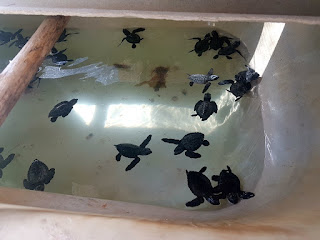
Baby turtles on Gili Meno

After that we walked to the lagoon in the centre of the island. We walked round the whole island (getting lost in the jungle for a while) before stopping for coffee which cost about £15 for 2. We spent the afternoon snorkelling and relaxing on the beach and looking for somewhere cheap for lunch. 

When we first arrived on Gili Meno we were a bit annoyed with ourselves for not spending a night or 2 there as it was beautiful. By the time we had walked the whole way round the island and seen the prices of food, we were glad we had stayed put on Gili Air. Food was much more expensive on Meno, probably because there was less choice, so less competition. 
Gili Meno beach
Reluctantly we had to say farewell to Gili Air as we were off to Amed in East Bali where I had signed up to do the PADI Open Water Divers’ course.

Bali, Amed

Amed is a well-known diving spot on the East coast of Bali and is actually a string of fishing villages. I had talked myself into doing the scuba diving course there and after some thought, Baby D decided not to do it with me. When we arrived at the dive centre Bali Diversity, the day before the 3 day programme started, to meet my instructor Mel and go over final details, Baby D changed his mind, deciding to do the course, and we were both nervous and excited about what was to come. 

Mel talked us into starting the course there and then, so we sat for 4 hours watching the video which went over all of the knowledge we needed to have for our final exam. The Open Water course is normally over 3 days, and ours included 4 dives and one session in the pool. We had to successfully carry out several practical exercises and on the final day we needed to take a 50 question multiple choice test.
Me and Baby D learning to dive

As soon as we arrived the following morning, we kitted up in wetsuits and we were off to the beach for the first dive. In at the deep end quite literally. We thought we’d be in the pool first, but no, that’s not how Mel does it and after instruction from her we were soon 5m down in the ocean. We swam around for 20 minutes or so finding our feet…or fins, and getting more at ease with being underwater and breathing through a regulator. 

We were both getting the hang of it fairly well until I inflated my BCD to go up a tiny bit (buoyancy control device which is like a waistcoat that you can inflate/deflate to adjust buoyancy), the button got stuck and I shot straight up to the surface. That was a bit scary on my first dive in 9 years, because we had already talked about the dangers of decompression sickness (the bends) when not going up slowly enough. Luckily we weren’t too deep and decompression sickness is not really an issue at that depth. Trust me to get the dodgy gear! (NB this was not because of poor quality kit, this could have happened to anyone and I have since spoken to a few divers who've had it happen to them!) Not part of the course, but after that, Mel made sure we knew exactly what to do in the unlikely event it happened again.

Undeterred, we headed off to the pool to practise removing and putting back our gear in case we got entangled under the sea; taking off and putting on our weight belts safely; and the tasks that every novice diver hates - emptying a mask full of water, and the ‘no-mask’ swim. Baby D had the water-filled mask down pat, but on my first attempt and missing the point completely, I tried to drown myself. I soon mastered it after that. 

The no-mask swim was a case of mind over matter. We had to sit underwater and slowly remove and then replace our masks, which would obviously be full of water by then, so we had to get rid of the water too. Once we had got that sorted, we did it all again but with a maskless swim chucked in the middle. Baby D, who had earlier easily removed his mask underwater without being told to, struggled a bit under pressure, but we were soon quite comfortable with it.
Amed sunset
We did 4 amazing dives (not counting the aborted dive when I broke the air nozzle), including the Liberty shipwreck, and the Coral Garden where there is a statue of a reclining Buddha. The day before the test we did a mock exam, and it was obvious we needed more revision, but we sailed through the test and that was it, we were qualified to dive together (and even without an instructor if we wanted to), to a depth of 18m. It was an amazing experience and we can’t wait for the next dive. 

Legian
Legian surf
Onto Legian for our last 2 nights in Bali, and in fact our last 2 nights in Asia. We’d been to Legian, a lively beach area near to the airport before, and it was an easy couple of days. We spent a couple of hours on the beach on our last day, I got another tattoo and my hair cut and we were soon off to the airport to fly to Perth in Western Australia. Both of us were sad to say goodbye to Asia as it was our home for 7 months, but new adventures await on a new continent. 

#indonesia #lombok #kutalombok #diving #padiopenwater #balidiversity #amed #libertyshipwreck #coralgardenbali #legian #giliair #h2oyoga
 #gilimenoturtlesanctuary